The science of acupuncture and moxibustion is a subject dealing
with the prevention and treatment of diseases by needling and
moxibustion methods. For thousands of years it has been accepted
by the general population for its good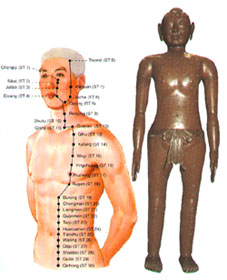 curative effect, wide range of indications, simple application,
low cost, safety, etc.
curative effect, wide range of indications, simple application,
low cost, safety, etc.
Acupuncture and moxibustion are an important component of
traditional Chinese medicine with a long history. As early as in
the New Stone Age in China, the primitive human beings used Bian
stone, the earliest acupuncture instrument, to treat diseases.
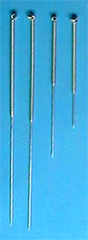
With the development of productive forces, bone needles and
bamboo needles appeared. After the development of metal casting
techniques and metal tools, the people began to use metal
medical needles, such as bronze, iron, gold and silver ones. At
present steel needles are widely used.
Moxibustion was gradually created after discovery and use of
fire. At first, primitive man found that warming themselves by
fire may relieve or stop cold pain of a part of the body. Thus,
they came to know how to use burnt hot stone or sand wrapped in
animal skin or bark to treat diseases through local hot
compression. Based on this, the people gradually perfected the
technique, using ignited branches or hay to warm the diseased
part of the body. This is the most primitive moxibustion.
Afterwards, the people selected moxa leaves as the moxibustion
material by repeated practice.
The science of acupuncture and moxibustion experienced an
uninterrupted course of development.
 In
the period of Warring States, ancient doctors widely used
acupuncture and moxibustion to treat diseases. Two silk scrolls
recording channels and collaterals, Moxibustion Classic with
Eleven Foot--Hand Channels and Moxibustion Classic with Eleven
Yin-yang Channels, were discovered in the excavation of the No.3
Han Tomb at Mawangdui, Changsha City, in 1973, which reflected
the earliest outlook of the theory of channels and collaterals.
The book Huangdi's Internal Classic, the earliest classic of
traditional Chinese medicine passed on to now, generally
discusses the basic theory of acupuncture and moxibustion and
the basic knowledge of point needling manipulations. Especially
in "Miraculous Pivot", one part of this book, it describes
acupuncture and moxibustion in detail and systematically. Thus,
another name of this part of the book is Canon of Acupuncture.
In
the period of Warring States, ancient doctors widely used
acupuncture and moxibustion to treat diseases. Two silk scrolls
recording channels and collaterals, Moxibustion Classic with
Eleven Foot--Hand Channels and Moxibustion Classic with Eleven
Yin-yang Channels, were discovered in the excavation of the No.3
Han Tomb at Mawangdui, Changsha City, in 1973, which reflected
the earliest outlook of the theory of channels and collaterals.
The book Huangdi's Internal Classic, the earliest classic of
traditional Chinese medicine passed on to now, generally
discusses the basic theory of acupuncture and moxibustion and
the basic knowledge of point needling manipulations. Especially
in "Miraculous Pivot", one part of this book, it describes
acupuncture and moxibustion in detail and systematically. Thus,
another name of this part of the book is Canon of Acupuncture.
From the Eastern Han Dynasty to the Three Kingdoms Period, the
science of acupuncture and moxibustion developed further. Hua
Tuo, the famous physician at that time, could select only one to
two points in acupuncture treatment and paid much attention to
the propagation of needling sensation. He was ascribed to the
authorship of Canon of Moxibustion and Acupuncture Preserved in
Pillow (Lost). Zhang Zhongjing, another physician in this
period, also elaborated the methods of acupuncture, moxibustion,
fire needling, warm needling, management of erroneous treatment
in acupuncture, etc. In the book Treatise on Febrile and
Miscellaneous Diseases, he stressed very much on combining
acupuncture with medicinal herbs in the treatment according to
the differentiation of symptom complex.
 The
famous medical doctor Huangfu Mi in the Jin Dynasty compiled the
book A--B Classic of Acupuncture and Moxibustion by collecting
the materials of acupuncture and moxibustion from the ancient
books Plain Questions, Canon of Acupuncture and Essentials of
Points, Acupuncture and Moxibustion. The book consists of 12
volumes with 128 chapters, including 349 acupoints. It tells the
locations, indications and manipulations of these points,
manipulating techniques and precautions of acupuncture and
moxibustion, and the treatment of common diseases by acupuncture
and moxibustion.
The
famous medical doctor Huangfu Mi in the Jin Dynasty compiled the
book A--B Classic of Acupuncture and Moxibustion by collecting
the materials of acupuncture and moxibustion from the ancient
books Plain Questions, Canon of Acupuncture and Essentials of
Points, Acupuncture and Moxibustion. The book consists of 12
volumes with 128 chapters, including 349 acupoints. It tells the
locations, indications and manipulations of these points,
manipulating techniques and precautions of acupuncture and
moxibustion, and the treatment of common diseases by acupuncture
and moxibustion.
During the Tang Dynasty, China was undergoing the process of
economical and cultural prosperity of the feudal society. The
science of acupuncture and moxibustion also witnessed great
development. In the late Sui and early Tang Dynasties, the
famous physician Sun Simiao compiled Prescriptions Worth a
Thousand Gold for Emergencies and A Supplement to the
Prescriptions Worth a Thousand Gold, in which a great deal of
clinical experience in acupuncture treatment of various schools
were included, and location and application of Ashi points were
introduced for the first time. He also designed and made three
multicolored hanging charts of acupuncture and
moxibustion--Charts of Three Views, which are the earliest
multicolored charts of channels and points, but have been lost.
Soon after, Wang Tao drew twelve multicolored hanging charts. He
also wrote the book The Medical Secrets of An Official, in which
a host of moxibustion methods were recorded. In the Imperial
Medical Bureau of the Tang Dynasty, the department of
acupuncture was an independent one, which housed personnel in
this field, such as professors of acupuncture, assistant
professors, instructors and students.
In the Song Dynasty, the extensive application of typecase
printing technique greatly promoted the wide application and
development of acupuncture and moxibustion. The famous medical
doctor Wang Weiyi revised the locations of the acupoints and
their related channels, and made a supplement to the indications
of acupuncture. In 1026 he wrote the book Illustrated Manual on
the Points for Acupuncture and Moxibustion of a New Bronze
Figure. The next year, two life-size bronze figures designed by
Wang Weiyi were manufactured. These were excellent medical
teaching models of the ancient times, and an important invention
of visual teaching in educational history.
Hua Shou, the famous doctor of the Yuan Dynasty, did textual
research on the pathways of channels and collaterals as well as
their relationship with acupuncture points. He wrote the book
Exposition of the Fourteen Channels, in which the Du and Ren
Channels, and the twelve regular channels are mentioned in the
same breath, making up the fourteen channels.
The famous acupuncturists He Ruoyu, Dou Hanqing, and others of
the Jin and Yuan Dynasties suggested that the acupuncture points
should be selected according to midnight-noon ebb-flow. They
explained the close relationship between selection and
compatible application of acupuncture points and the time.
In the Ming Dynasty, acupuncture and moxibustion were worked up
to a climax. Many famous doctors specialized in this field
emerged with many exclusive books on acupuncture and
moxibustion, such as A Complete Collection of Acupuncture and
Moxibustion, by Xu Feng, An Exemplary Collection of Acupuncture
and Moxibustion and Essentials of Acupuncture and Moxibustion by
Gao Wu. But the most important one was the book Compendium of
Acupuncture and Moxibustion by Yang Jizhou, which was a new
milestone in the history of development of acupuncture and
moxibustion science. Yang Jizhou wrote the book on the basis of
his ancestor's book Mysterious Secrets of Acupuncture and
Moxibustion combined with the summarization of his own clinical
experience. His book describes the channels and collaterals,
acupuncture points, manipulating methods of acupuncture and
their indications. It also introduces the experience in the
treatment of diseases by acupuncture combined with herbal
medicines, and records the cases of successes and failures by
acupuncture and moxibustion, a comparatively comprehensive
summary of the achievements of acupuncture and moxibustion
before the Ming Dynasty.
In the Qing Dynasty, certain progress was made in the
development of science of acupuncture and moxibustion. There
came the book Golden Mirror of Medicine, Essentials of
Acupuncture and Moxibustion in Verse compiled by Wu Qian and his
collaborators, the book The Source of Acupuncture and
Moxibustion compiled by Li Xuechuan, and others at this period.
During the middle and late periods of the Qing Dynasty, however,
the authorities of the Qing Dynasty issued a decree to abolish
the acupuncture-moxibustion department from the Imperial Medial
College under the pretext that "acupuncture and moxibustion are
not suitable to be applied to the Emperor". So, acupuncture and
moxibustion were restrained to a certain extent. But the
treatment by acupuncture and moxibustion was widely accepted by
the broad masses, and spread and used among the common people
widely.
Since the founding of the People's Republic of China, the
science of acupuncture and moxibustion has developed vigorously
because of the implementation of the policies for traditional
Chinese medicine. The therapy by acupuncture and moxibustion has
been popularized extensively in China. On the basis of exploring
and inheriting the traditional acupuncture and moxibustion,
modern scientific knowledge is applied to the research work.
For example, according to the principle of acupuncture
analgesia, acupuncture anesthesia has been creatively developed
and popularized in clinical practice, and the experimental
research on it has been carried on. Since the 1970s,
investigations have been done on the mechanism of acupuncture
analgesia and therapy by acupuncture and moxibustion from the
viewpoints of neuroanatomy, pain physiology, biochemistry,
medicinal electronics, etc., on the phenomena and nature of the
channels from the viewpoints of propagated acupuncture sensation
and other angles, and on the relationship between acupuncture
points and zhang-fu organs, between acupuncture points and
needling sensation.
Acupuncture and moxibustion were introduced abroad, and
popularized and applied in many countries long ago. They are the
important content of the medical exchanges between China and
foreign countries, and have made great contributions to the
people's health.
Since the 1950s, the international spread of the science of
acupuncture and moxibustion has become widened. Many countries
have sent their doctors to China to learn acupuncture and
moxibustion. Particularly after 1971 when China made known the
achievements of acupuncture anesthesia, acupuncture anesthesia
evoked strong repercussions in study and searching acupuncture,
moxibustion and acupuncture anesthesia was set off. Since 1975,
at the request of the World Health Organization, the
International Acupuncture Training Courses have been offered in
Beijing, Shanghai and Nanjing, and acupuncturists have been
trained for many countries. Up to now, acupuncture and
moxibustion are being used and studied with good results in more
than one hundred countries. The World Association of Acupuncture
and Moxibustion was founded in 1987. Since then, the Chinese
academic society of acupuncture and moxibustion has further
strengthened the connections and exchanges with the
corresponding academic organizations of various countries; and
China will certainly make new contributions to the development
of acupuncture and moxibustion all over the world.