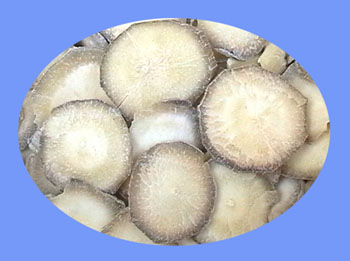
|
Prepared Aconite
Root
(fu zi)
Radix
Aconiti Praeparata
Properties:
The herb is pungent in flaour, hot in nature,
and toxic. It acts on the heart, spleen kidney
channels. Being extremely pungent, the herb is
good at supplementing fire and Yang, dispersing
yin-cold, helping heart-yang, warming
spleen-yang and kidney-yang, dispersing cold
alleviating pain, and recuperating depleted Yang
to rescue patients from collapse. Therefore, it
is used to treat cold syndrome in the upper, the
lower, the interior and the exterior.
Effects:
Supplementing fire and Yang, dispersing cold,
alleviating pain, and recuperating depleted Yang
to rescue patients from collapse.
Indications:
1. To treat
deficiency of Yang-Qi and excessive Yin-cold in
the interior with symptoms of cold limbs,
profuse sweating and indistinct pulse, i. e Yang
depletion, the herb is often used in combination
with dried ginger and liquorice for
strengthening the effects of recuperating
depleted Yang to rescue patients from collapse,
such as Sini Decoction.
2. The herb is
often used in combination with Chinese cassia
bark, prepared rehmannia root, dogwood fruit and
other herbs for supplementing fire and Yang,
warming and replenishing essence and blood, to
treat cold pain in the waist and knee, aversion
to cold, cold limbs, frequent micturition,
impotence, sterility and other syndromes caused
by deficiency of kidney-yang and decline of the
fire from the gate life; with dangshen, white
atractylodes rhizome and dried ginger for
warming and replenishing the spleen and kidney,
dispersing cold and arresting diarrhea, such as
Fuzi Lizhong Pill, to treat Yang-deficiency of
the spleen and kidney, cold pain in the stomach
and abdomen, loose stool, cold body and limbs;
and with atractylodes rhizome, poria and other
herbs for warming Yang, inducing diuresis and
alleviating edema, to treat deficiency of
kidney-yang, impaired water metabolism, edema
and dysuria.
3. The herb can be
used in combination with cinnamom twig, white
atractylodes rhizome, clematis root and other
herbs for dispersing cold and alleviating pain,
to treat arthralgia due to wind-cold or
excessive cold; and with cinnamom twig,
chuanxiong, Chinese angelica root and other
herbs for warming the channels, dispersing cold,
regulating menstruation and alleviating pain, to
treat cold menses, stagnation of blood,
dysmenorrhea and amenorrhea.
Dosage and Administration:
3-15g. When prepared for a decoction, the herb
should be boiled for 30-60 minutes in order to
reduce its toxicity, before other drugs are
added.
Precautions:
Contraindicated in pregnancy. In properties, the
herb is opposite to pinellia tuber, mongolian
snakegourd fruit, fritillary bulb, ampelopsis
and hyacinth bletilla, and rhinoceros horm.
Appendix: Aconite
Root
Aconite root is
divided into Sichuan aconite root and wild
aconite root. Sichuan aconite root is the axial
root of the perennial herbaceous plant Aconium
carmichaeli debx. of family Ranunculaceae; and
wild aconite root is the tuber of Aconitum
rusnezoffii Reichb. Similar to prepared aconite
root in nature, flavour, channel tropism and
effects, aconite root is particularly good at
expelling wind, removing dampness, dispersing
cold and alleviating pain. However, in toxicity,
aconite root is stronger than prepared aconite
root, and wild aconite root is stronger than
prepared aconite root, and wild aconite root is
stronger than Sichuan aconite root . The dosage
is 3-9g for Sichuan aconite root and 1.5-4.5g
for wild aconite root orally taken. When
prepared for a decoction aconite root should be
boiled for 30-60 minutes in order to reduce its
toxicity before other drugs are added. Its
precautions are the same as those of prepared
aconite root. |